Friday, March 21, 2014

Amendment X

AMENDMENT X

The powers not delegated to the United States by the Constitution, nor prohibited by it to the states, are reserved to the states respectively, or to the people.
This amendment was put in the constitution to give peace to the anti-federalist who were afraid the federal government held too much power.  It clarifies that any power not expressly given to the government, can be held by the states or simply the people themselves.  
Media:
Medical_marijuana
This political cartoon depicts the differences between the powers of state and federal power.  The federal government has the power to make marijuana illegal, as well as the paraphernalia associated with it, but states are beginning to legalize it for both medicinal and recreational use.  There becomes this issue of blurred lines between the powers expressly given to the federal government and the power the states can claim for themselves when it comes to legalization of marijuana. 

Amendment IX

AMENDMENT IX

The enumeration in the Constitution, of certain rights, shall not be construed to deny or disparage others retained by the people.
This amendment states that their may be other rights entitled to Americans that are not explicitly stated in the constitution, but should still be regarded as a basic right and not violated. 
Media
This YouTube clip depicts senator Rick Santorum deflecting the use of medical marijuana under the 9th amendment and saying the government just has the right to say no because its bad.  A report brings to light that if Americans have the right to choose their own doctors and medicine, than under the 9th amendment shouldn't they have the right to choose medical marijuana as a form of treatment for cancer? 

Amendment VIII

AMENDMENT VIII

Excessive bail shall not be required, nor excessive fines imposed, nor cruel and unusual punishments inflicted.
The amendment states the bail cannot be disproportionate to the actual crime committed, yet it must be reasonable enough to ensure that the accused will show up for trial.  There also must not be any form of cruel or unusual punishment, which is up to interpretation for the most part, but protects the accused from any sort of abusive behavior by the authorities.  
Media:
This political cartoon is criticizing the differing believes between Democrats and Republicans.  It is satirizing the hypocrisy of being either pro-life but for the death penalty or vise versa.  Basically the cartoonist believes if you are for life, you should be consistent, and same for if you are pro-choice.   The death penalty is a hot topic of debate in regards to the 8th amendment because some classify it as a "cruel or unusual" punishment, while others deem it necessary. 

Amendment VII

AMENDMENT VII

In suits at common law, where the value in controversy shall exceed twenty dollars, the right of trial by jury shall be preserved, and no fact tried by a jury, shall be otherwise reexamined in any court of the United States, than according to the rules of the common law.
In modern day times, you are not allowed to go to federal court for amounts under $75,000, as opposed to the $20 amount in the constitution.  This amendment also clarifies that a person cannot set up their own court system, the court must be recognized by the government.
Media:
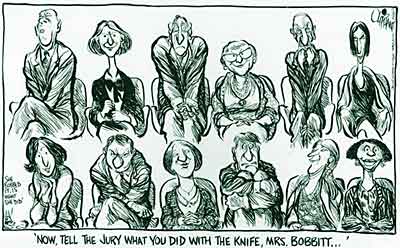
Jury
This political cartoon illustrates the requirement by the 7th amendment to have a trial by jury, and emphasizes that the courts must be recognized by the government and proceed with the rules of common law.

Wednesday, March 19, 2014

Amendment VI

AMENDMENT VI

In all criminal prosecutions, the accused shall enjoy the right to a speedy and public trial, by an impartial jury of the state and district wherein the crime shall have been committed, which district shall have been previously ascertained by law, and to be informed of the nature and cause of the accusation; to be confronted with the witnesses against him; to have compulsory process for obtaining witnesses in his favor, and to have the assistance of counsel for his defense.

The right to a speedy and public trial grants the accused the liberty of not having to sit in jail for extended periods of time waiting for their trial to come to court, and publicly asking questions ensures there are multiple witnesses to prevent any illegal questioning practices.  The jury must be unbiased and impartial to the crime committed or the accused person himself, and the trial must take place in the district in which the crime took place.  The accused person also has the right to know exactly what they are being accused with and who is accusing them.  They also have the right to either bring or summon witnesses to court if it will be in their favor.   
Media 1:

This is a clip from the movie 21 Jumpstreet, in which two police officers forget to read their accused their Miranda rights, and therefore the police department was forced to drop charges.  Complete disregard of the Miranda rights is a direct violation of the 6th amendment, as the accused have the right to know exactly what they are being charged with and their rights as accused individuals.  

Media 2:

The government is only required to inform a person of their Miranda rights if they have been arrested.  If they bring a person in for questioning, without officially placing them under arrest, they are not required to inform a person of their lives. 

Amendment V

Amendment V

No person shall be held to answer for a capital, or otherwise infamous crime, unless on a presentment or indictment of a grand jury, except in cases arising in the land or naval forces, or in the militia, when in actual service in time of war or public danger; nor shall any person be subject for the same offense to be twice put in jeopardy of life or limb; nor shall be compelled in any criminal case to be a witness against himself, nor be deprived of life, liberty, or property, without due process of law; nor shall private property be taken for public use, without just compensation.

This amendment guarantees that an American citizen cannot be convicted of a crime without evidence or witnesses to present in front of a grand jury.  The only exception to this rule would be in an emergency situation for military forces.  Also, a person cannot be tried twice for the same crime.  Once a criminal sentence has been completed, they cannot be taken to court again for the same crime.  This amendment also states that no person is required to testify against themselves in court, meaning in order to be convicted of a crime, there must be reasonable evidence or witnesses.  The final two clauses of this amendment state that due process of law must always be taken into affect to protect citizens' rights and any seizure of private property must be justly compensated.  

Media 1:


Unfortunately, this program isn't letting me embed this YouTube video, but the link should still work.  This clip from a popular TV show, The Good Wife, is an excellent example of the utilization of our 5th amendment rights.  A woman refuses to answer a question in court due to the fact that it may cause self-incrimination.  


Media 2:

This political cartoon demonstrates how a person is not required to testify against themselves in court.  Although the lawyer in the cartoon is saying that by not speaking, the defendant is admitting his guilt, when in reality he is just taking advantage of his fifth amendment right. 

Amendment IV

aMENDMENT iv

The right of the people to be secure in their persons, houses, papers, and effects, against unreasonable searches and seizures, shall not be violated, and no warrants shall issue, but upon probable cause, supported by oath or affirmation, and particularly describing the place to be searched, and the persons or things to be seized.


This amendment protects people from having their property searched or seized without probable cause or good reason.  This protects American's privacy as a whole and ensures their right to tranquility in the home.  This also protects American's from having their phone's tapped unless a warrant was procured.  

Media 1:


Media 2:


These two political cartoons are criticisms of the patriot act, which in the opinion of many Americans was a violation of our 4th amendment rights because it was a direct invasion of privacy.  The patriot act of 2001 allowed the government to seize records and collect electronic surveillance without a warrant in terrorist situations.  Many Americans thought this act was unconstitutional because it was a seizure of their personal information and invasion of privacy.